Shade, Strings, and Slow Coffee: Inside Wakati Wetu's Sunday Morning Reset

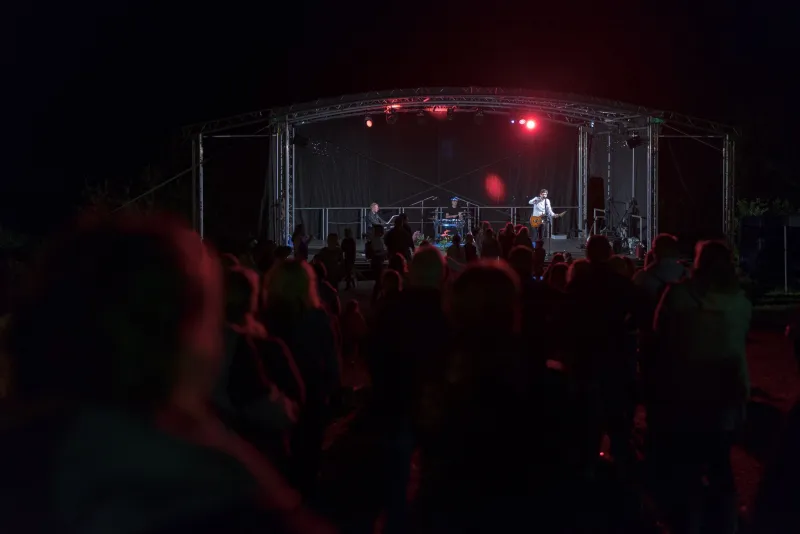
Photo: Tuomas Vitikainen, CC BY-SA 4.0, via Wikimedia Commons
At 9:42 on a Sunday morning, Wakati Wetu is a different festival. The main field still smells like yesterday’s rain and fried dough. A volunteer is stacking folding chairs with the care of someone handling glass. The big rig is covered. Under a shade sail near the edge of the grounds, a duo is tuning an acoustic guitar and a kalimba while about forty people sit on blankets. A toddler is asleep. Nobody is shouting over a kick drum. This is the festival’s Sunday morning window — not one hour exactly, more like a slow three-hour exhale — and it may be the most radical thing on the schedule.
Festivals are built to increase intensity. More bass, more lights, more bodies, more late-night. Wakati Wetu is no exception. But the Sunday morning slot runs the other way. It asks artists to play quieter, asks the production crew to hold the volume, and asks attendees to arrive without the usual festival armor of earplugs, hydration packs, and elbows-out positioning. For a US festival audience trained on tailgate energy and state-fair crowds, that can feel almost suspicious. What is a festival morning for if not to get a jump on the day?
The Slot That Does Not Ask You to Yell
The programming is simple on paper: acoustic sets, small ensembles, spoken word, a low-key DJ set at conversation volume, and a few seated workshops. In practice, it takes coordination. The main stage stays dark. The sound team uses a separate, smaller PA. Vendors are asked to keep generators and blenders from competing with the music. Shade is treated as infrastructure, not decoration. There are more chairs than usual, more water stations, and a clear path around the crowd so people can leave without climbing over blankets.
That may sound like basic hospitality. At a festival, it is a design choice. The quiet window gives parents a place to land before the day gets loud. It gives sensory-sensitive attendees a stretch of time when the grounds are navigable. It gives artists a chance to play material that would disappear under a festival main-stage mix. And it gives the whole site a reset before the afternoon crowd arrives.
What Parents and Sensitive Ears Told Us
Several parents described the Sunday morning slot as the reason they bought a weekend pass instead of a single day. One mother from Chicago said she plans her family’s arrival around it: breakfast at the hotel, sunscreen at the gate, blankets down by 9:15. Another parent said the low-volume window lets a kid who hates loud rooms practice being at a festival without being overwhelmed. That is not a small thing. For families, the difference between a festival that works and one that does not is often a single calm place to sit.
Sensory-sensitive attendees made a similar point. A festival is a lot of input: crowds, lights, bass, heat, lines. The Sunday morning program does not remove all of that, but it lowers the stakes. One attendee told me they use the window to walk the grounds and learn the layout before the site fills up. Another said they bring noise-canceling earbuds anyway, but they rarely need them before noon. The slot is not a cure-all. It is a door left open.
The Artists’ Side of the Monitor
For performers, the quiet window is a different kind of gig. There is no wall of sound to hide behind. A missed note is a missed note. But artists who have played the slot describe it as one of the most attentive audiences of the weekend. People are there on purpose. They are not waiting for a headliner or holding a spot at the rail. They are listening.
One guitarist who has played both the main stage and the morning set said the smaller crowd changes the material. Songs that get swallowed outdoors can breathe in a seated, shaded space. A singer who usually fronts a full band can try a stripped-down arrangement. A poet can work without shouting. The festival does not bill the slot as a prestige gig, but the artists who take it seriously tend to leave with a different relationship to the audience. That matters for a festival built around African music and diaspora community. The quiet window is not background music. It is a conversation.
How to Do Sunday Morning Right
If you are coming from a hotel or a rental on the edge of town, aim to arrive before the music starts. The grounds are cooler, the lines are shorter, and you can claim shade without a strategy session. Bring a blanket or a low chair if the festival allows it. Pack water and a hat, and check the schedule for the exact start of the low-volume block — it is usually listed separately from the main-stage program. If you have a family member who needs a quiet exit, walk the perimeter first so you know where the gaps are.
US festival-goers often treat Sunday as a travel day. That is understandable. But the morning slot rewards a later flight or a slower checkout. If you are driving, give yourself an extra hour. If you are flying, do not book the earliest shuttle. The quiet window is not a reason to rush. It is a reason to sit still for a while.
Why It Might Be the Most Radical Booking
A festival that makes room for low volume is making a statement about who belongs. Not every attendee can stand for six hours. Not every kid can nap in a bass pocket. Not every artist wants to shout. The Sunday morning window does not solve every access problem, and it does not replace the need for quiet rooms or trained staff. But it puts a stake in the ground. It says the soft part of the day is not leftover time. It is part of the program.
By 12:30, the shade sail will be packed away and the main field will start to hum. The bass will return. The lines will stretch. But for a few hours, Wakati Wetu will have been a festival you could hear yourself think in. That is not a warm-up. It is the whole point.