The Circle Has a Host: How to Join Wakati Wetu’s Community Music Without Making It About You
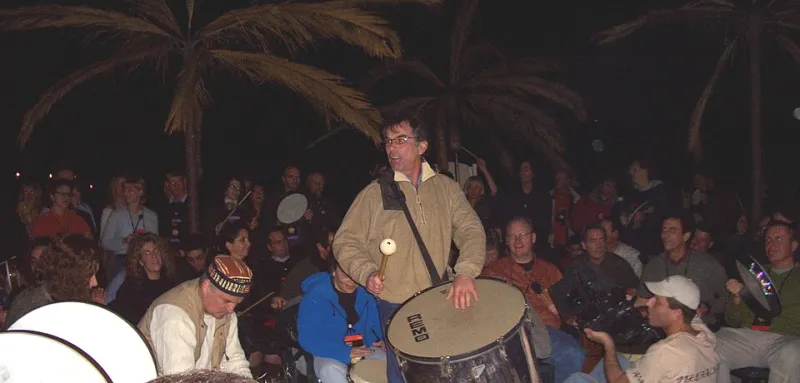
Photo: Steve Jurvetson from Menlo Park, USA, CC BY 2.0, via Wikimedia Commons
At Wakati Wetu 2026, the community music area is easy to find. You hear it before you see it: a low rumble of djembes, a shaker holding steady, a caller sending a phrase into the air and a few dozen people sending it back. For a first-timer from the U.S., it can feel like an invitation with no RSVP required.
It is an invitation. It also has a host, a shape, and a set of expectations. That is the part worth learning before you dive in.
The Circle Has a Host
“We open the circle,” says Nana Adjei, who helps lead community programming at Wakati Wetu. “We don’t open a stage.”
That distinction matters. A stage is built for separation: performer here, audience there. A circle is built for connection, but connection still needs a lead. At Wakati Wetu, the lead might be a drummer keeping time, a singer calling a chorus, or a dance facilitator showing a step. They are not background entertainment. They are hosts.
“If people treat the circle like a photo op, the energy changes,” Adjei says. “You can feel it. People stop listening to each other and start watching themselves.”
Participation Is Not Performance
Festivals blur lines. That is part of the fun. But community music is not an audition, and it is not a content opportunity. It is a shared room with a shared pulse.
Drummer and teacher Ama Serwaa puts it simply: “If you are playing louder than the person next to you, you are probably not listening.”
That does not mean you have to be quiet. It means you have to be in the mix. Participation is joining the conversation. Performance is trying to win it.
Ask, Watch, Then Join
You do not need permission to clap. You do need a little awareness before you grab a drum, jump into a dance line, or start a solo.
- Do ask first. A simple “Is it okay if I join?” goes a long way. If the answer is no, take it gracefully.
- Do watch for a full cycle. Listen to the pattern before you add to it. Figure out where the pulse sits.
- Do learn the chorus. Call-and-response is built for repetition. Catch the phrase, then join when it comes around.
- Don’t assume every circle is open. Some moments are for specific communities, specific ages, or specific ceremonies. If it is not for you, enjoy it from the edge.
- Don’t correct the lead. If you think the rhythm shifted, check your own hands first.
- Don’t pull people into the middle. Invitations should be offers, not orders.
If you would not grab the tongs at a stranger’s cookout, do not grab the drumsticks at a community jam. Wait to be handed something.
Call-and-Response Is a Conversation
Call-and-response can look easy from the outside: someone sings, you sing back. In practice, it is a conversation with timing, volume, and respect.
Wait for the gap. Match the energy without drowning out the caller. If the phrase is in Twi, Yoruba, Lingala, or another language you do not speak, you do not need to fake an accent. Join the vowel sounds, keep the rhythm, and stay humble. Curiosity is welcome. Mockery is not.
“You can hear when someone is listening,” Serwaa says. “They leave space. They come in on time. They do not try to put their own flavor on top of everything.”
Dance Invitations Have Edges
A dance circle is not a mosh pit. It is not a free-for-all, and it is not a chance to test someone’s personal space because the music is loud.
Consent is not a vibe. It is a question. If someone invites you in, follow the steps you are shown. Keep your hands to yourself unless you are clearly invited to partner. Do not lift, spin, or pull anyone who has not agreed. Do not assume that a smile is a full invitation. And if you are lost, step to the side and watch. That is participation too.
Put the Phone Down
Filming can turn a shared moment into content before anyone has agreed to be in the frame. At Wakati Wetu, the community music area is not a backdrop for your feed.
Ask before photographing people, especially children. Skip the flash. Do not stand in the middle of the circle to get the shot. If you must take a photo, take it from outside the circle and keep it quick. Better yet, leave the phone in your pocket and tell the story later. The memory will be sharper than the clip.
Know When to Step Back
Stepping out is not failure. If you lose the pulse, if you feel yourself forcing it, if the energy is not yours to carry, step back and listen. The circle will keep going. You can rejoin when you are ready.
After the jam, ask a host what you were hearing. Ask what the song was, where it comes from, or what the call meant. That kind of curiosity builds more connection than a perfect solo ever will.
The Point Is Company
Community music is not a test of how African you are, how good you are, or how fast you can learn a rhythm. It is a practice of company. The goal is not to prove you belong. The goal is to add without subtracting.
So clap. Sing the part you know. Ask before you play. Follow the lead. Put the phone away. And when the circle opens, step in like a guest who is glad to be there — not like a star who has finally found a stage.