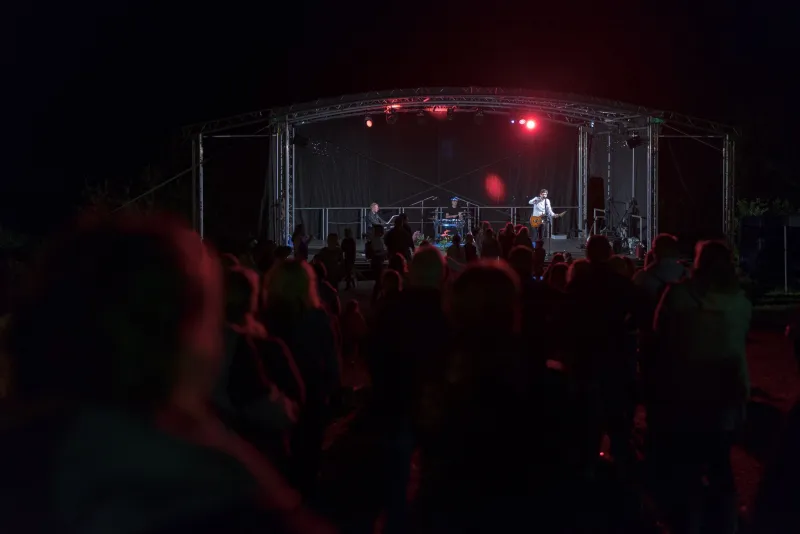
What Gets Said Between Soundcheck and Showtime: Notes From Wakati Wetu’s Artist Green Room

Photo: Dotun55, CC BY-SA 4.0, via Wikimedia Commons
The green room at Wakati Wetu does not announce itself. There is no badge scanner at the door, no panel title on a clipboard, no sponsor banner asking to be photographed. On a Saturday during this year’s festival, it was just a room with mismatched couches, a kettle that had seen better days, a bowl of oranges, and a tangle of charging cables near the wall.
That is where the real schedule was hiding.
At 2:17 p.m., five musicians pulled their chairs into something like a circle. One had flown in from Accra. One was based in Johannesburg and touring the US for the first time. Two came from Brooklyn and the DC area. Another had driven in from Houston. A festival production coordinator closed the door, checked that nobody was waiting on a soundcheck, and said the thing that made the room go quiet for half a second: “This is yours. No audience. No recording. Ask the questions you don’t want to ask onstage.”
A Room With No Badge Scanner
The session was not listed anywhere. It was not in the app. It was not on the printed program. If you were scrolling the Wakati Wetu lineup for main-stage acts, you would have missed it entirely.
That anonymity is deliberate. The mentorship hours are part of the festival’s behind-the-scenes rhythm, but they are not a product. They are not a content shoot. They are a place for artists to compare notes without performing expertise for a crowd. The topics shift depending on who is in the room, but the core is steady: the practical stuff that never fits into a soundcheck.
A visiting artist asked about US work visas. A diaspora musician from Brooklyn talked about the difference between a booking inquiry that sounds real and one that is fishing for a free set. Someone else wanted to know how to read a festival contract without calling a lawyer for every small clause. The coordinator mostly listened and occasionally translated between the language of the stage and the language of the office.
First Lesson: The Paper Trail
The first twenty minutes were about paperwork, which is not glamorous but is, in practice, the opening act for most international careers.
The group talked about petition timelines and the cost of premium processing. They compared notes on O-1 and P-2 categories without pretending anyone in the room was an immigration attorney. A guitarist from Accra said the hardest part was not the form itself but the waiting. A Houston-based singer nodded and said the hardest part was explaining to a venue why a confirmed date could still fall apart if a document did not land in time.
Then came contracts. There was talk of deposits, backline rentals, merch percentages, and the difference between a guarantee and a promise with nice formatting. One musician said she now asks for a simple rider addendum: who pays for the extra monitor, who covers the airport transfer, and what happens if the set gets cut by fifteen minutes because another act ran long.
Nobody was handing out legal advice. That is not the point. The point is that the questions get asked out loud, in a room where asking them does not make you look green.
Second Lesson: The Ten Minutes Before Soundcheck
By 2:45, the conversation moved to the part of the day most audiences never see: the ten minutes before soundcheck.
A drummer from Johannesburg described a festival in Europe where the monitor mix changed three times in five minutes. A Brooklyn bassist said he now brings a small notebook with the exact phrases he uses with monitor engineers: “More vocal in the wedge,” “Less kick in my ears,” “Can I hear the click only on the count-in?” The room laughed, but people wrote things down.
They talked about stage plots that look clean on paper and chaotic on the floor. They talked about what to do when the venue’s backline is not what the rider promised. One artist said she always asks for a five-minute line check with the full band, even if the schedule is tight, because a rushed check is cheaper than a bad first song.
There was also the matter of the audience. A US-based musician from the DC area said diaspora crowds can be generous and demanding at the same time. They know the songs. They know the features. They will sing the harmony louder than the monitor. “You have to leave room for them,” she said. “The crowd is not background vocals. The crowd is part of the arrangement.”
Third Lesson: Stagecraft Is Community Care
The last stretch of the afternoon was less technical and more human. How do you talk to a crowd that speaks three languages and has been standing for four hours? How do you handle a false start? How do you introduce a song that is political without turning the set into a lecture? How do you end on time when the audience wants one more?
A visiting artist said that in his experience, the best festival sets are not the loudest ones. They are the ones where the band looks like it knows where it is. That means cue cards taped to the floor. That means a setlist with room to breathe. That means a designated person to watch the clock, so the front person does not have to.
A diaspora musician added something that stuck: “Stagecraft is community care. If the audience feels safe, they will go where you take them.”
That line could have been a panel quote. Instead, it landed in a green room with no microphones, between a conversation about tax forms and a reminder that the next act needed the room in ten minutes.
Why the Unlisted Hours Travel
The main stage is what people buy tickets for, and rightly so. But the green room mentorship hours may be the festival’s most durable export. They do not depend on a big production budget. They do not need a livestream. They travel home in the heads of the people who sat in that circle.
A visiting artist leaves with a better sense of how US festivals actually run. A US-based diaspora musician leaves with a sharper map of the scenes that sent those artists to the stage. Both leave with phone numbers. That is the kind of infrastructure you cannot print on a poster.
Wakati Wetu means our time. In the green room, that phrase gets practical. The time is not only for the show. It is for the questions that make the show possible.
What the Green Room Leaves Behind
By 3:05, the room had emptied. The oranges were gone. Someone had left a setlist on the couch with a phone number scribbled on the back. The next act was already outside, waiting for the door.
There was no applause. No encore. Just a quiet exchange that will show up later in a better soundcheck, a cleaner contract, a calmer border crossing, or a set that lands because the artist knew exactly who was in the room with them.
That is not a headline. It is a classroom. And at Wakati Wetu, it is happening just behind the schedule, one unlisted afternoon at a time.